I love writing. It helps me to express myself and I feel free while writing. So, I cherish my blogs like kids, and wonder if they could make money for me one day…
Well, I’m a still English beginner and I don’t feel completely free yet. The reason are not only my vocabulary is lacking but you don’t know ー&〜. If you’re curious about Japanese slangs, you might have seen them at least once. Today, I’ll explain it in detail!
At first, I asked ChatGPT about these differences and here’s the reply.
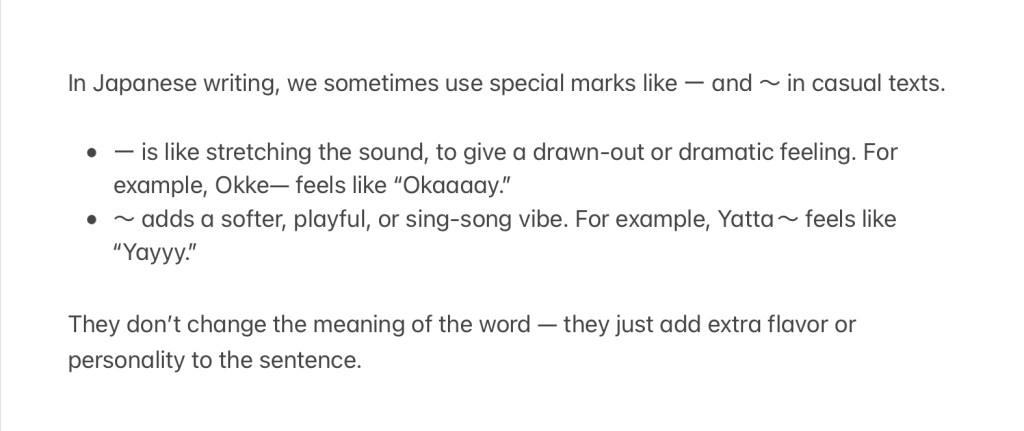
For example, in Japanese, when we say “ok,” we can write it as おっけー or おっけ〜. The latter, with the wave 〜, feels softer, lighter, and more relaxed. Generally, women use it more than men (including me).
Some people occasionally use the half-width ~, like this(おっけ~), but that’s pretty rare. Those people are probably more curious and easily bored. After all, they got tired of ー and 〜, so they try to express themselves with something even trickier, like ~. Their Japanese is usually a bit messy too, so for beginners, be careful not to try to understand all what they’re saying. In other words, people who use ~ are likely to be interesting, because they pay attention to such tiny details.
Of course, as I’m a writer, I enjoy switching between them depending on my mood when chatting. But in English, there’s nothing like that… which is honestly kind of sad. That’s why I want to use them in English too. やったー!
***But… Caution:
Also ー and 〜 carry sounds in Japanese, おっけ= okke, おっけー = okkeee, so something like “greatー” would sound strange. And ー is the same as kanji ー ( it means the number one, 1). It’s too complicated, I’m so sorry( ◠‿◠ )
So, 〜 is easier to understand, and I recommend using that. If I use it in English, I probably go with the half-width ~ to make it feel softer. I wouldn’t use ー and the half-width – . This is more about feelings than rules ~
Can you follow me so far? Hope you’re smiling…
But if you ever read Japanese, this might be useful to know! Language is fun, isn’t it ? Bye~
 Hana Toyoda
コメントを残す